

WEB ARCHITECTURE GUIDE
If You Already Have a WebSocket, Should You Still Use REST?
Your app already has a persistent WebSocket connection. Should ordinary API requests move onto it too? Here is how to decide when HTTP remains simpler and when WebSocket commands make sense.
Your app already receives live events over an open WebSocket:
message.created
user.online
notification.created
order.updated
Now you need to let users update their profile. You could keep the familiar HTTP endpoint:
PUT /api/profileOr send a command through the connection you already have:
{
  "type": "profile.update",
  "name": "Alice"
}
Why keep REST if the socket is already open?
An open WebSocket is not, by itself, a reason to move ordinary request/response operations onto it. HTTP often remains simpler for independent actions with a clear result. WebSocket commands become more useful when an operation belongs to an ongoing bidirectional interaction.
One terminology note: REST and HTTP are not synonymous. Here, “REST” is shorthand for the application's conventional HTTP API, with endpoints such as GET /orders and PUT /api/profile.
What you start building on top of WebSocket
After sending profile.update, the client needs to know whether it worked. You could send back profile.updated with success: true.
But what if several commands are in flight? Now each response needs to identify the command it answers. Add a request ID so replies can be correlated with commands:
{
  "id": "req-42",
  "type": "profile.update",
  "name": "Alice"
}
The server replies:
{
  "replyTo": "req-42",
  "success": true
}
You also need a way to report errors:
{
  "replyTo": "req-42",
  "success": false,
  "error": "EMAIL_ALREADY_EXISTS"
}
What if no reply arrives within five seconds? The client needs a timeout. What if the connection drops just after sending?
Command sent → connection lost
             → did the server process it?
Retrying may be reasonable. If the first attempt succeeded, though, a retry can perform the operation twice. A request ID that matches replies to commands does not automatically prevent duplicate execution; the application needs a duplicate-handling policy too.
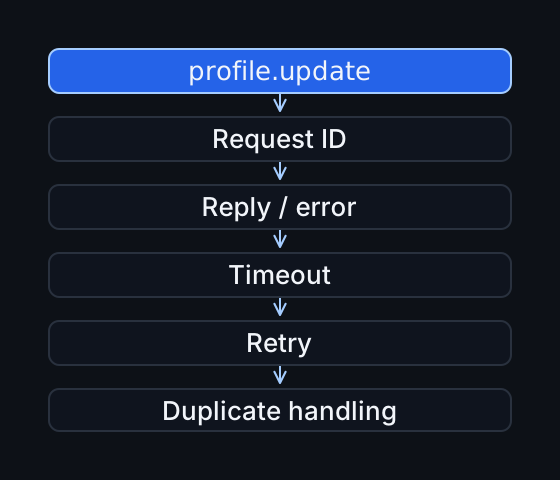
These are application-level decisions. WebSocket provides two-way communication and message framing; it does not define the meaning of your commands or replies.
Building that application protocol can be justified. Having an open socket does not make the extra work free.
Why HTTP remains convenient for independent operations
With HTTP, the same PUT /api/profile already has a familiar request/response lifecycle: method, URL, status code, and response body. Browser DevTools, API clients, proxies, monitoring, and tracing already understand that model.
HTTP does not implement your business logic, choose a retry policy, or make every operation idempotent. Those decisions still belong to the application.
But if users occasionally change their display name, timezone, notification settings, or profile picture, an HTTP endpoint often stays simpler than adding another command type to a WebSocket protocol.
When WebSocket commands make sense
Consider a multiplayer game. The client continuously sends move, shoot, turn, and ready. The server sends player.moved, state.updated, round.started, and player.disconnected.
This is a persistent bidirectional session. The messages belong to an ongoing interaction rather than a handful of occasional, independent operations.
The same can apply to collaborative editors, some trading systems, interactive control systems, and other applications with frequent two-way messages.
In these systems, message IDs, acknowledgements, reconnect behavior, and recovery are already part of the application protocol. Sending commands through WebSocket can be a natural fit.
HTTP commands and WebSocket events work together
A chat application can reasonably use both:
HTTP
GET  /messages
POST /messages
PUT  /api/profile

WebSocket
message.created
message.read
user.typing
user.online
The user sends a message with POST /messages. The server responds with 201 Created, then other connected clients receive message.created over WebSocket.
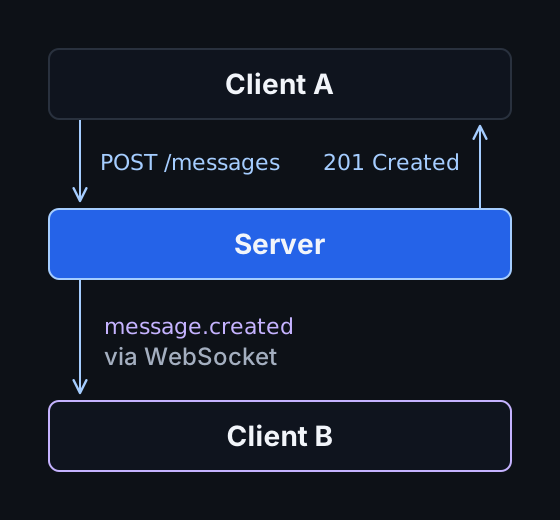
The two messages have different roles:
- HTTP command: “Create this message.”
- WebSocket event: “A message was created.”
An orders feature can work the same way: POST /orders creates an order, while WebSocket delivers order.created, order.filled, and order.cancelled events.
Keeping REST and WebSocket together is a normal hybrid architecture. Each handles the interaction it describes well.
Two questions that help you choose
1. Does the operation make sense without the WebSocket connection?
Changing a password, updating a profile, creating a report, or changing a timezone usually still makes sense while the socket is temporarily disconnected. An independent HTTP endpoint is often a natural fit.
Moving a player in a live game is different: once the realtime session is lost, the action may no longer make sense. WebSocket fits that session-dependent operation much better.
2. Is this an independent operation or part of an ongoing live interaction?
Updating notification settings has a clear beginning and end. Continuously sending collaborative edits belongs to a longer conversation between client and server.
That distinction is usually more useful than asking which transport is faster.
Where PayloadPigeon fits
Debugging a hybrid application means following both kinds of traffic. One feature might produce:
POST /orders → 201 Created

WebSocket:
order.created
order.updated
Chrome DevTools can inspect HTTP requests and WebSocket messages, and it is enough for many debugging tasks.
PayloadPigeon can help when you want to capture and inspect real HTTP and WebSocket traffic together in the browser, especially when one feature combines request/response operations with realtime events. If you then need to test how the UI handles a changed, delayed, or missing message, see the WebSocket testing guide.
The tool does not choose your architecture. First identify what each message represents: a command, response, notification, subscription, or acknowledgement. Knowing those roles makes the traffic easier to read.
Does this operation belong to the live WebSocket session, or does an independent HTTP request already describe it better?